About Harry Adams’ Series Paintings
Harry Adams often makes groups of work to be presented as a single series, both as a creative exercise and to make unique work available at a more affordable price.
Usually taking a common starting point and allowing each painting to develop individually. Sometimes they employ print techniques to either contain or disrupt the work, but this series is all hand painted in oils and glaze on traditional gesso coated boards.
About this Series
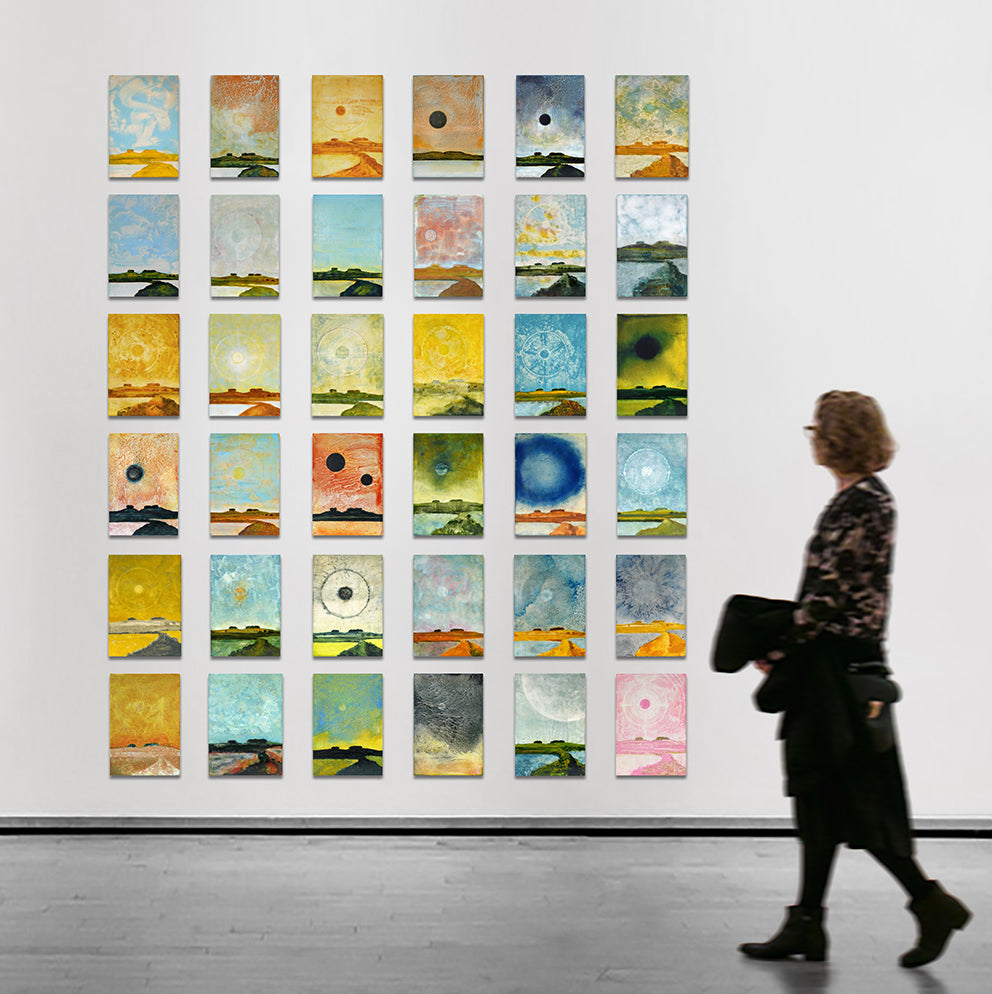
To The Pent Cuckoo series is based on a photograph of the Wittenham Clumps taken from a book called the Myth of the Pent Cuckoo: A Study in Folklore by J. E. Field (Elliot Stock, London 1913).
One of the clumps is topped by a group of trees sometimes known as The Cuckoo Pen. There are many Cuckoo Pens in the UK and the origin is from an ancient story that was first printed in a book called The Wise Men of Gotham (first published in 1540). It’s a tale usually told to show the vainglorious stupidity of man, with a group of fools believing that if they could trap a cuckoo there would be eternal summer. They build a hedge or fence around the bird to contain it, but it simply flies over the top and away. The other angle to the story and others from the Wise Men of Gotham is that the villagers were pretending to be mad to deter the King from coming to stay in their village. If he had stayed they would have had to build a new road and lavishly entertain him, which they couldn’t afford to do. In those days madness was considered contagious so they enacted an array of apparently crazy activities to deter him from coming in fear of catching their insanity.
These small paintings by Harry Adams show a pathway winding
towards the Wittenham Clumps (also known as Mother Dunch’s Buttocks or, more properly, the Sinodun Hills). In the photo a raised footpath crosses a ploughed field but in these versions it has become a causeway across a flooded plain, with a couple of paintings where the causeway has disappeared beneath the water altogether. The works in the series wax and wane between pictorial solidity and evocative disintegration as suns/moons/celestial bodies come and go.
Made over a short period of intense painting, this series is offered up as an evocation to the coming Summer Solstice: to honour the cycles of mother nature and the creative spirit, but also as a reminder of the cunning nature of artists and, of course, the foolishness of man.